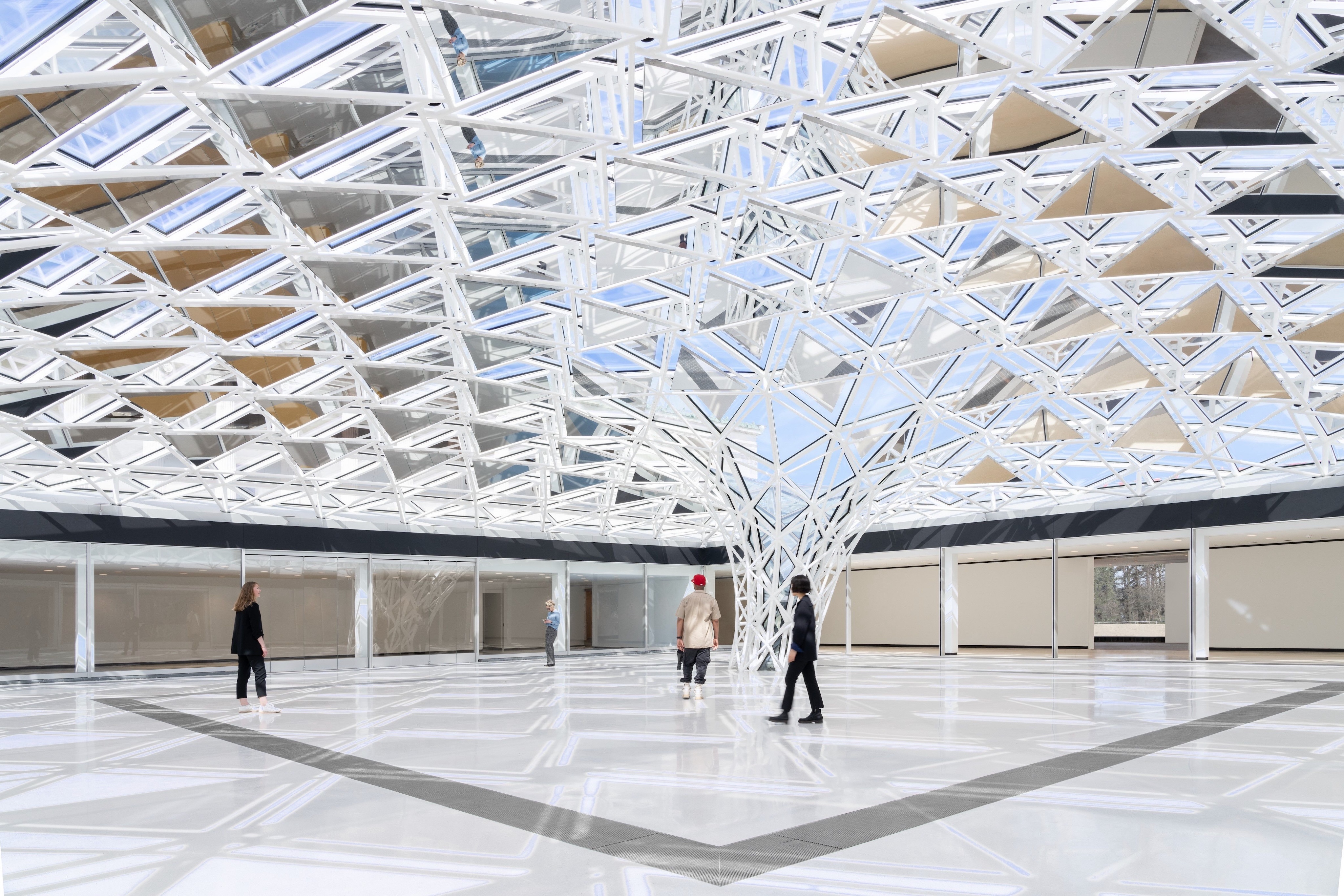
Tiede-Zoeller’s century of expertise meets a landmark design for museum expansion—pushing the material to new limits and earning national recognition.
BUFFALO, NY, UNITED STATES, June 3, 2026 /EINPresswire.com/ — The design vision for the Jeffrey E. Gundlach Building at the Buffalo AKG Art Museum was ambitious. The new gallery was to be inserted into the context of the original gallery, a 1905 Beaux-Arts landmark.
The structure would need a single, durable material that could bridge historic and contemporary spaces, provide subtle shifts in texture and color, and carry a coherent visual language throughout what would become a major civic cultural institution. The vision was clear. The path to executing its details was not.
That’s where Tiede-Zoeller Tile Corp. of Cheektowaga, N.Y., a firm celebrating its 100th anniversary this year, came in. The contractor’s terrazzo expertise and readiness to engineer solutions that the design had not yet fully specified and that had not previously been attempted proved essential to bringing the project to completion. That partnership has earned a 2026 Honor Award from the National Terrazzo & Mosaic Association (NTMA). The award was presented to Tiede-Zoeller on May 13 at the association’s annual convention.
A Material Pushed to Its Limits
Cooper Robertson, acquired by Corgan in 2025, served as executive architect on the project, in collaboration with design architect OMA New York, led by partner Shohei Shigematsu and project architects Lawrence Siu and Paxton Sheldahl. From the outset, the team sought a monolithic, natural material with enough range to cross varied surfaces and unify old and new.
The design called for terrazzo in a variety of configurations — not as a static finish but as a flexible design tool to enhance the cohesiveness of the tightly constrained material palette. The new gallery incorporated epoxy terrazzo on all four floors, along with an elevated serpentine structure that bridges to the original gallery.
The installation spans 31 distinct color mixes in a subtle chromatic progression throughout the building, the full range of terrazzo aggregates — from micro-blend mixes to large-format Palladiana — for both horizontal and vertical surface applications, and a series of custom terrazzo air grilles embedded in the floor.
“Terrazzo is a beautiful natural element; it plays off all the abundant natural light in the gallery through the day and through the seasons,” said Jason Cadorette with Corgan, a key member of the executive architecture team for the museum expansion.
“We try to stretch its limits,” Mr. Cadorette added. “We love terrazzo because it’s a monolithic, durable material, but it’s also versatile. We try to use it in as many different ways as we can.”
A Gradient That Moves With You
At the center of the Gundlach Building is a precast cylindrical monumental staircase: the visual anchor of the new structure. Its 102 straight and radius treads and risers are fabricated from 28 separate design mixes. Colors shift in a subtle gradient from terracotta tones at the lower levels to light pewter hues above, creating a continuous chromatic thread through the building.
The museum’s “Tree of Life Courtyard” is a glass-domed space centered on a monumental glass art tree. On the floor, a micro-aggregate blend terrazzo mix was cast over a hydronic radiant-heated slab.
In the second-floor atrium, the design team wanted a “show-stopping element” at its entry. Tiede-Zoeller designed and installed a handcrafted Palladiana terrazzo floor dubbed “Buffalo Winter.” To evoke the effect of falling snow, the pattern transitions gradually from large irregular marble slabs into finer Venetian terrazzo, an official NTMA classification for terrazzo that uses larger aggregate chips than standard mixes. Each space was unique, while terrazzo, both precast and poured-in-place, brings cohesion to the gallery as a whole.
Engineering Without a Precedent
The design called for 152 removable terrazzo air grilles installed flush with the surrounding floor throughout the building, but the specification stopped there, with no established standard to follow. No prior installation was known to have used precast terrazzo for foot-traffic bearing grilles.
It fell to Tiede-Zoeller to develop the engineering solution: 5/8-inch epoxy terrazzo bonded to a 1/4-inch stainless steel plate for structural support, then waterjet-cut to final form. Because the grilles were positioned adjacent to exterior windows, condensation management required precise calibration of the opening dimensions. The terrazzo contractor spent several months designing and engineering the final grille system in close coordination with the architecture team and the precast vendor before production began.
“Tiede-Zoeller’s many decades of expertise in the terrazzo industry were essential,” Mr. Cadorette said of the process. “They didn’t say no to our requests, except when something really couldn’t be done. Great partners: that’s the recipe for a great project.”
About the National Terrazzo & Mosaic Association
The annual NTMA Honor Awards recognize outstanding terrazzo installations completed by association member contractors. Entries are evaluated by design professionals and terrazzo specialists on design achievement, craftsmanship, and technical execution. A full list of this year’s 17 Honor Award recipients is available at ntma.com.
Founded in 1923, the NTMA is a nonprofit trade association of over 150 contractor and supplier members, headquartered in Fredericksburg, Texas. The organization establishes national standards for all terrazzo systems and applications, advancing quality craftsmanship and innovation while supporting its members in the trade.
The NTMA provides a broad range of free resources for architects, designers, artists, contractors, maintenance professionals, and property owners. From assisting design teams with specifications to offering technical guidance throughout a project, the NTMA helps ensure terrazzo installations meet the highest standards. The association also offers AIA-registered continuing education programs for architects and design professionals. For more information about terrazzo resources, visit ntma.com. Technical Director Gary French is available at gary@ntma.com.
Terrazzo originated in 15th-century Italy, building on the mosaic traditions of ancient Rome. Venetian marble workers repurposed discarded stone chips into durable, decorative surfaces—a practice that made terrazzo an early sustainable material. Today, terrazzo is still poured by hand on-site, with options for precast panels and waterjet-cut details. Stone, recycled glass, or other aggregates—which may be locally sourced—are set in a cement or epoxy base, and the surface is then polished to reveal the aggregate’s color and texture. Valued for its design versatility, ease of maintenance, durability, sustainability, and lifecycle value, terrazzo is built to last the life of a building.
Chad Rakow
National Terrazzo & Mosaic Assocation
+1 800-323-9736
info@ntma.com
Visit us on social media:
LinkedIn
Instagram
Facebook
YouTube
TikTok
National Terrazzo & Mosaic Association 2026 Honor Awards
Legal Disclaimer:
EIN Presswire provides this news content “as is” without warranty of any kind. We do not accept any responsibility or liability
for the accuracy, content, images, videos, licenses, completeness, legality, or reliability of the information contained in this
article. If you have any complaints or copyright issues related to this article, kindly contact the author above.

Media gallery