
Shenzhen, Guangdong, China – November 28, 2026
Standard Versus High-Capacity Cassettes: What a Wholesale Cash Dispensing ATM Supplier Recommends
Managing physical cash logistics across dispersed self-service banking networks requires balancing hardware acquisition costs against long-term cash-in-transit (CIT) operational expenses. Financial institutions, independent deployment network operators, and retail vault managers must evaluate how cash transport mechanics directly impact operational liquidity. Partnering with a specialized Wholesale Cash Dispensing ATM Supplier enables deployment teams to select appropriate cassette capacities, note transport mechanisms, and security safe enclosures tailored to specific transaction volumes. Unplanned cash replenishment dispatches quickly increase operating overhead, while over-allocating capital in high-capacity vault modules locks up excess cash reserves. Evaluating self-service banking hardware requires analyzing how standard dispensing modules, high-capacity closed-loop note recyclers, and coin handling units align with local transaction velocity and site-specific operational demands.
The Kinematics of Cash Management: Rethinking CIT Costs and Operational Liquidity
Deploying automated financial hardware involves complex logistics far beyond initial terminal installation. Armored car dispatches represent a heavy recurring operational expense that accumulates rapidly when terminals require frequent cash replenishment. Every manual vault reload requires scheduled transit routing, dual-custody armed security personnel, and localized terminal downtime. Conversely, loading maximum note volumes into every terminal ties up substantial working capital that yields no interest while sitting idle inside the safe enclosure.
Financial network managers must calculate the velocity of cash flow across individual deployment locations. High-traffic transit nodes experience intense cash depletion rates, whereas suburban retail branches often see balanced or unpredictable transaction ratios. Matching internal cassette capacity with empirical transaction data optimizes replenishment schedules, reduces armored transit visits, and keeps idle cash reserves within acceptable operational limits.
Single-Dispense vs. High-Capacity Recycling: Architectural Mechanics Compared
The internal mechanical architecture of a cash handling module dictates how a terminal processes physical currency. Standard cash dispensing mechanisms utilize single-direction note transport systems. These configurations draw banknotes from dedicated storage cassettes, pass them through optical and mechanical thickness sensors to detect double-feed errors, and present verified bills to the user. Standard dispensers suit locations with steady, predictable withdrawal volumes where daily transaction counts remain within manageable limits.
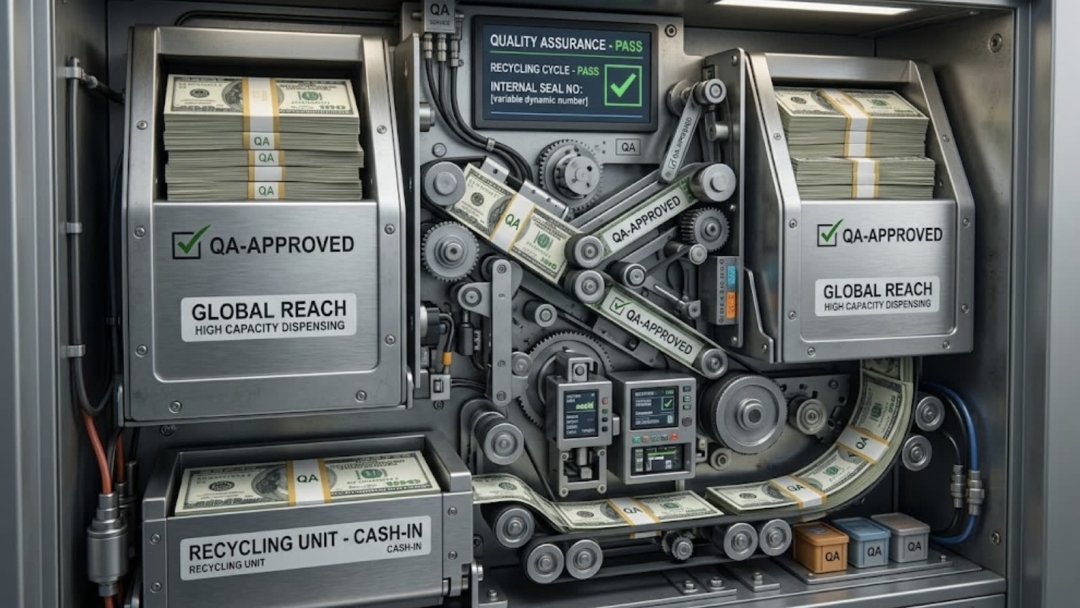
In contrast, high-capacity bulk cash recycling architectures introduce closed-loop currency processing. Advanced recycling modules accept incoming cash deposits, evaluate bill authenticity through multi-spectrum optical and magnetic sensors, and sort valid banknotes into high-capacity storage cassettes for immediate payout to subsequent users. This closed-loop mechanism dramatically extends CIT replenishment intervals by recycling deposited funds locally. Furthermore, advanced dual note-and-coin recycling platforms integrate specialized coin acceptance and payout hoppers, delivering full-denomination automated transactions for municipal payment centers, parking hubs, and busy retail venues.
Deployment Matrix: Selecting the Right Cassette Architecture Based on Foot Traffic and Refill Frequency
Selecting optimal cassette configurations requires matching hardware architectures with site-specific foot traffic metrics and transaction types. Low-to-medium traffic environments, such as convenience stores, hotel lobbies, and small medical clinics, typically experience low daily note turnover. Deploying compact, wall-mounted, or through-the-wall cash dispensers in these space-constrained venues keeps capital expenditure low while providing essential withdrawal services. These units offer sufficient note capacity to handle steady transaction rates without accumulating excess uncirculated capital.
Conversely, high-volume commercial centers, international airports, transit hubs, and drive-thru banking corridors demand high-capacity multi-cassette platforms. These bustling sites process thousands of daily transactions, making standard dispensers prone to frequent note depletion. Installing bulk multi-cassette recycling terminals allows high-traffic sites to absorb large cash deposits while maintaining continuous withdrawal liquidity. This closed-loop capability lengthens cash replenishment cycles from days to weeks, significantly lowering overall transit expenses and improving network uptime.
Financial Hardware Portfolio: ZKTEK’s Engineered Cash Handling Ecosystem
Engineering financial self-service platforms for global deployments requires versatile product lines and robust mechanical construction. ZKTEK (SHENZHEN ZHONGKONG COMPUTERS CO., LTD.) designs a broad spectrum of automated cash management hardware engineered to meet diverse banking and retail operational requirements. For space-constrained sites requiring reliable note payout, compact cash dispensers such as the AW32 and AW33 provide efficient footprint utilization and secure single-note feeding mechanisms. Similarly, the AW38 series integrates through-the-wall housing with thermal receipt printing, offering secure wall-mounted transaction services for branch exteriors. For versatile interactive service points, the AW61 platform combines financial transaction security with a sleek, user-friendly interactive chassis.
To support high-density commercial locations requiring extended replenishment cycles, specialized cash-dispensing ATM platforms and bulk recycling terminals deliver continuous closed-loop performance. Heavy-duty platforms like the AW91 and TTW60 through-the-wall recycling ATM process high-volume bulk note deposits and withdrawals through advanced multi-cassette modules and secure rear-maintenance access. Furthermore, complete automated currency management configurations incorporate specialized modules such as the AW-CPS-PRO3 and AW-CPS-PRO6 systems, which combine bulk note recycling with automated coin acceptance and multi-denomination payout hoppers. These comprehensive systems, alongside specialized sub-assemblies like the EXP50, provide complete self-service automation for financial institutions and enterprise retail networks.
Quality Assurance and Custom OEM/ODM Engineering with ZKTEK
Deploying automated financial hardware across international markets demands strict adherence to global physical security guidelines and standardized manufacturing protocols. Financial self-service terminals undergo rigorous structural engineering to comply with UL291 safe enclosure guidelines, PCI payment security standards, and ISO 9001 quality management frameworks. Reinforced steel safe enclosures, drill-resistant locking mechanisms, and secure cable management channels protect internal currency cassettes from physical tampering and unauthorized access.
Understanding cash flow dynamics and site logistics helps financial institutions choose hardware architectures that optimize operational costs. Partnering with an experienced factory team provides access to flexible cassette configurations, custom peripheral integration, and tailored OEM/ODM engineering support. Evaluating hardware suppliers based on verified security compliance, module reliability, and versatile product lines ensures long-term operational efficiency across diverse self-service banking networks.
To explore financial self-service kiosks, cash recycling ATMs, and custom OEM/ODM banking solutions, visit https://www.zktek.com/.
About Us
Founded in 2010, ZKTEK is an original manufacturer of touchscreen computerized kiosks, with over 15 years of industry experience and registered capital exceeding USD 1.4 million.
ZKTEK specializes in the design, customization, manufacturing, and optimization of self-service touchscreen solutions, including ATM kiosks, interactive kiosks, touchscreen monitors, smart lockers, currency exchange machines, and cash recycling systems. Our solutions serve demanding applications across banking, healthcare, insurance, airports, hospitality, gaming, ticketing, vending, billing, logistics, industrial computing, and security.
More than a hardware supplier, ZKTEK provides integrated, project-specific solutions, combining customized hardware, self-developed components, and software integration capabilities. From enclosure design and I/O systems to cabling, packaging, SDKs, software interfaces, and application integration, we support projects from concept to mass production.
Our experienced engineering and manufacturing teams enable us to:
Understand and develop complex requirements based on extensive industry and international project experience.
Customize components and systems, including housings, I/O, wiring, and packaging.
Support software integration and development, including SDKs, WebKit-based libraries, application integration, and interface development.
Over the years, ZKTEK has developed hundreds of touchscreen-based models and delivered solutions for a wide range of innovative self-service applications.
With flexible hardware and software integration, advanced manufacturing capabilities, and continuous technology development, ZKTEK is committed to delivering reliable, scalable, and cost-effective self-service solutions that maximize project value and ROI.
Media Contact
Company Name: ZKTEK
Contact Person: Media Relations
Email: Send Email
Country: China
Website: https://www.zktek.com/
Press Release Distributed by ABNewswire.com
To view the original version on ABNewswire visit: Standard Versus High-Capacity Cassettes: What a Wholesale Cash Dispensing ATM Supplier Recommends