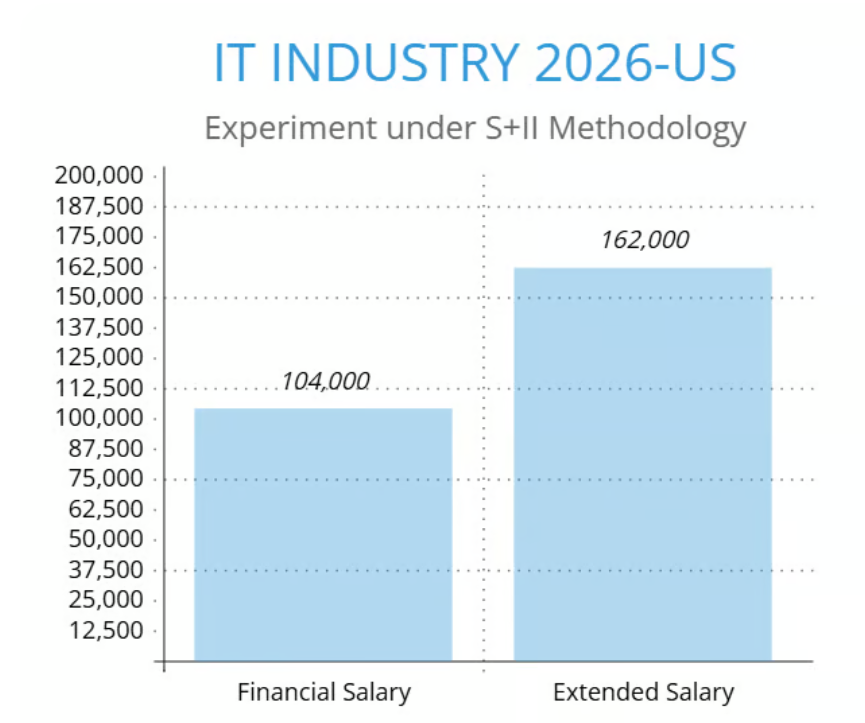
This is a research study based on experimentation about effective economic value generated by flexible work arrangements in companies in the IT US industry
LEWES, DE, UNITED STATES, May 28, 2026 /EINPresswire.com/ — Econtime Consultants, has released a groundbreaking 2026 modeling experiment demonstrating the profound economic benefits of flexible work arrangements (FWA) for software programming professionals in the United States.
The case study, authored by Econtime Consultants Principal George Monray, calculates the “extended salary” of IT professionals by evaluating the Economic Value of Personal Time (EVPT) alongside traditional financial compensation. While the average net financial salary for a U.S. programmer is currently $104,000, the study reveals that the equivalent “extended salary” scales up to $162,768. This represents a 56% increase in value added directly to employees’ lives through workplace flexibility.
To uncover the real economic impact of remote work, the simulation analyzed a demographic average of 39-year-old programmers with one to two children, an average longevity expectation of approximately 79 years, and a 29% debt-to-asset ratio. By applying a subjective time valuation where time off is considered 1.5 times more valuable than working time, alongside an assumed 90% positive health perception, Econtime Consultants determined the EVPT—the economic price of each free hour for an employee—to be $193.79.
The experiment highlights a stark contrast in time valuation: while the financial price per hour worked is calculated at $48.17, the value of an employee’s personal time scales to $193.79. Assuming that employees recover an average of 6 hours of personal time per week due to remote work—which currently accounts for 65% of their 40-hour workweek—the compounded value becomes highly lucrative.
The model comprehensively adjusted for the direct costs and savings of working from home. Although remote employees take on additional utility, heating, air conditioning, and internet costs, they save significantly on commute-related expenses. These savings include reclaimed hours that would have been lost behind the wheel, as well as the elimination of parking costs, gas expenses, and vehicle depreciation.
Due to its highly favorable flexibility metrics, the U.S. IT software programming industry would hypothetically qualify for the Salary+ Impact Index® Platinum Certification for 2026. With an index score of 56% (5.6), the sector comfortably exceeds the 1.3-point threshold required to achieve the highest certification tier.
“Now is the time to communicate these positive results to IT employees across the United States. Without a doubt, this will help improve the industry’s reputation while making it easier to attract and retain talent,” said George Monray, CEO of Econtime.
Econtime Consultants notes that these findings are derived from an experimental framework using assumed variables and statistical projections, and should be interpreted as analytical trend models rather than absolute factual records. This publication is strictly for informational and academic purposes and does not constitute financial, legal, or professional advice.
George (Jorge) Monray
Econtime Consultants
+34 633 93 48 45
email us here
Visit us on social media:
LinkedIn
Other
Legal Disclaimer:
EIN Presswire provides this news content “as is” without warranty of any kind. We do not accept any responsibility or liability
for the accuracy, content, images, videos, licenses, completeness, legality, or reliability of the information contained in this
article. If you have any complaints or copyright issues related to this article, kindly contact the author above.

Media gallery