Enterprise Content Management Market is expanding as organizations adopt AI, cloud platforms, and automation for secure content management.
NEW YORK(NY), NY, UNITED STATES, July 28, 2026 /EINPresswire.com/ — The Enterprise Content Management (ECM) market has evolved into one of the most strategically significant segments of the global enterprise software industry, underpinning the digital operations of organizations across every major sector. ECM encompasses a comprehensive suite of technologies, strategies, and processes designed to capture, manage, store, preserve, and deliver content and documents related to organizational processes. As enterprises grapple with exponentially growing volumes of structured and unstructured data, the ability to efficiently govern, retrieve, and leverage content assets has become a fundamental competitive differentiator.
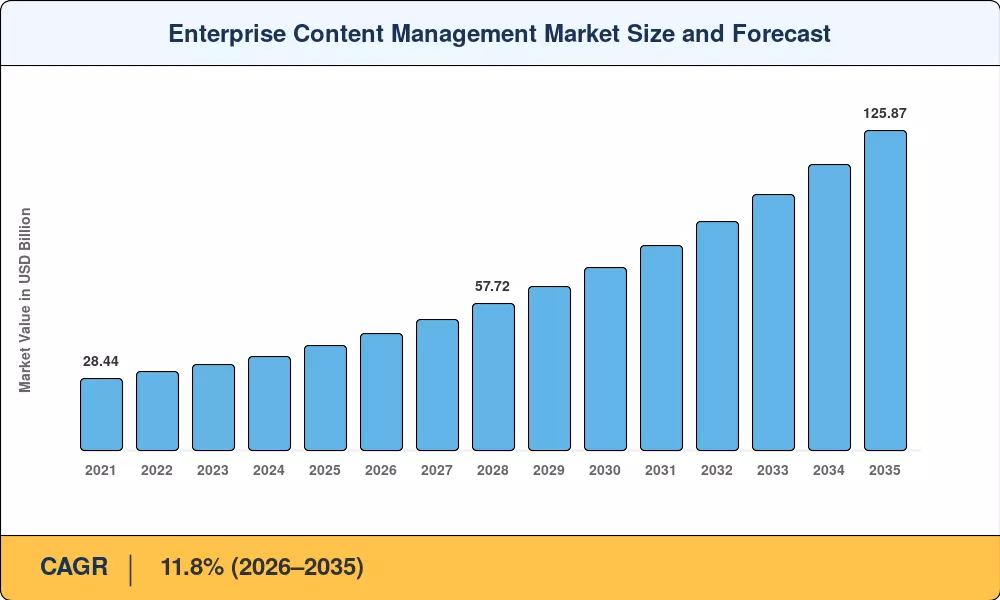
The convergence of cloud computing, artificial intelligence, automation, and advanced analytics has dramatically expanded the capabilities of modern ECM platforms, transforming them from static document repositories into dynamic, intelligent content services hubs that drive operational efficiency, regulatory compliance, and superior customer engagement. Organizations across banking, healthcare, government, legal, manufacturing, and retail sectors are increasingly recognizing ECM not merely as a back-office utility, but as a core enabler of digital transformation strategies. The Enterprise Content Management Market reached an estimated USD 41.25 Billion in 2025 and is projected to grow from USD 46.12 Billion in 2026 to USD 125.87 Billion by 2035, registering a CAGR of 11.8% during the forecast period.
Leading Industry Participants
The ECM market is shaped by a competitive mix of global technology conglomerates, specialist content management vendors, and agile cloud-native challengers. These organizations are actively investing in platform modernization, AI-powered features, cloud-native architectures, and strategic acquisitions to consolidate market share and broaden their solution portfolios. The following are the key industry participants defining the trajectory of the global ECM market:
• OpenText Corporation
• Microsoft Corporation
• IBM Corporation
• Hyland Software
• Laserfiche
• Box Inc.
• DocuWare
• M-Files Corporation
• Xerox Corporation
• Alfresco (Hyland)
• Oracle Corporation
• SAP SE
Download Sample Pages of Research Overview –
https://www.marketresearchfuture.com/sample_request/3915
Key Growth Factors
A confluence of powerful macro and technology trends is accelerating the adoption of ECM solutions across global enterprises. The relentless growth in digital content volumes, including emails, contracts, invoices, multimedia files, and collaborative documents, is placing immense pressure on organizations to implement structured content governance frameworks that ECM platforms provide.
Stringent regulatory requirements such as GDPR, HIPAA, SOX, and various national data retention mandates are compelling enterprises to invest in ECM solutions that enable precise records management, audit trails, and defensible deletion policies. The ongoing migration to cloud infrastructure is a particularly potent catalyst, enabling organizations to access scalable, cost-efficient ECM capabilities without the capital expenditure burden of on-premise deployments.
The integration of artificial intelligence and machine learning into ECM platforms, enabling capabilities such as automated document classification, intelligent metadata tagging, optical character recognition, and contract analytics, is significantly expanding the value proposition of these platforms for knowledge workers and compliance teams alike. Furthermore, the widespread shift to hybrid and remote work models has elevated demand for secure, cloud-accessible content management tools that support distributed teams, electronic approvals, and digital collaboration at enterprise scale.
Emerging Growth Opportunities
The ECM landscape is rich with emerging opportunities that are poised to redefine the market’s growth trajectory over the coming decade. The integration of generative AI and large language models into ECM platforms presents a transformative opportunity, enabling organizations to interact with their content repositories through natural language queries, auto-generate document summaries, extract insights from unstructured data at scale, and streamline contract review and legal document processing. The growing adoption of intelligent process automation (IPA) and robotic process automation (RPA) within ECM workflows offers significant efficiency gains in document-intensive processes such as accounts payable, claims processing, patient onboarding, and regulatory submissions.
The expansion of ECM capabilities into mobile-first and edge computing environments is creating new use cases in field service management, logistics, and retail operations. Small and medium-sized enterprises represent a largely underpenetrated segment, with cloud-based, subscription-driven ECM offerings increasingly making enterprise-grade content management accessible to this tier. Additionally, the convergence of ECM with customer experience management, digital asset management, and customer communications management is enabling vendors to deliver unified content platforms that serve both internal governance and customer-facing content delivery needs.
Buy Now the Detailed Report –
https://www.marketresearchfuture.com/checkout?currency=one_user-USD&report_id=3915
Key Market Barriers & Challenges
Despite the strong demand fundamentals driving ECM adoption, the market contends with a set of persistent barriers that vendors and buyers must navigate carefully. The complexity of migrating large volumes of legacy content from aging repositories or paper-based filing systems to modern ECM platforms presents a significant implementation challenge, often requiring substantial investment in content remediation, metadata standardization, and change management. Data security and privacy concerns remain a critical impediment, particularly as organizations weigh the risks of storing sensitive legal, financial, and personal documents on cloud-based platforms operated by third-party vendors.
The total cost of ownership for comprehensive ECM deployments encompassing licensing, implementation, training, integration, and ongoing support can be prohibitive for budget-constrained organizations. Resistance to organizational change and low user adoption rates are recurring challenges, as ECM systems that are not intuitive or tightly integrated into existing workflows often fail to deliver their full potential value. Furthermore, the rapid pace of technological evolution in this space means that organizations risk investing in platforms that may become obsolete or require costly upgrades as the market transitions toward intelligent content services and AI-native architectures.
Segment-wise Market Breakdown
The Enterprise Content Management market can be analyzed across multiple segmentation dimensions, each offering distinct insights into where demand is concentrated and where growth momentum is strongest:
By Component:
• Software (Document Management
• Records Management
• Web Content Management
• Digital Asset Management
• Workflow & Process Management)
• Services (Professional Services, Managed Services)
By Deployment Model:
• Cloud-Based ECM (Public Cloud, Private Cloud, Hybrid Cloud)
• On-Premise ECM
By Organization Size:
• Large Enterprises
• Small and Medium-Sized Enterprises (SMEs)
By End-Use Industry:
• Banking,
• Financial Services & Insurance (BFSI)
• Healthcare & Life Sciences
• Government & Public Sector
• Legal & Compliance
• Retail & E-Commerce
• Manufacturing
• Energy & Utilities
• Education
• Media & Entertainment
By Functionality:
• Document Capture & Imaging
• Document Management & Storage
• Records & Compliance Management
• Workflow & Business Process Automation
• Collaboration & Knowledge Management
• Analytics & Reporting
By Geography:
• North America
• Europe
• Asia-Pacific
• Latin America
• Middle East & Africa
Browse In-depth Market Research Report –
https://www.marketresearchfuture.com/reports/enterprise-content-management-market-3915
Geographical Market Insights
Geographically, North America maintains its position as the dominant region in the global ECM market, accounting for the largest revenue share owing to its mature enterprise IT ecosystem, early adoption of cloud technologies, and stringent regulatory environment that mandates robust records management and compliance frameworks. The United States, in particular, remains the single largest national market, driven by heavy ECM adoption across financial services, healthcare, legal, and government sectors. Europe represents the second-largest regional market, with the United Kingdom, Germany, France, and the Nordic countries leading adoption, partly fueled by GDPR compliance requirements that have made structured document governance a regulatory imperative.
The Asia-Pacific region is on track to deliver the fastest compound annual growth rate through 2035, powered by accelerating digital transformation initiatives across China, India, Japan, South Korea, and the ASEAN economies, combined with rapid cloud infrastructure buildout and growing regulatory standardization across industries. Government digitalization programs in countries such as India (Digital India), Singapore (Smart Nation), and the UAE (Paperless Government) are creating substantial demand for ECM solutions in the public sector. Latin America and the Middle East & Africa, while still nascent ECM markets relative to North America and Europe, are gaining momentum as enterprises in these regions accelerate their digital modernization efforts and seek scalable content management platforms to support expanding regulatory compliance requirements.
Frequently Asked Questions (FAQs)
Q1. What is the current market size of the Enterprise Content Management industry?
The Enterprise Content Management market reached an estimated USD 41.25 Billion in 2025. It is projected to grow from USD 46.12 Billion in 2026 to USD 125.87 Billion by 2035, advancing at a compound annual growth rate (CAGR) of 11.8% during the forecast period.
Q2. What is driving the rapid growth of the ECM market?
Key growth drivers include surging digital content volumes, escalating regulatory compliance requirements, widespread cloud adoption, the integration of AI and machine learning into content platforms, and the shift to remote and hybrid work models that demand secure, cloud-accessible document management solutions.
Q3. Which industries are the largest adopters of ECM solutions?
Banking, Financial Services and Insurance (BFSI), healthcare and life sciences, government and public sector, and legal services are among the largest adopters of ECM solutions, owing to their high document volumes, strict regulatory requirements, and need for secure, auditable records management frameworks.
Q4. Who are the leading players in the Enterprise Content Management market?
The leading players in the ECM market include OpenText, Microsoft, IBM, Hyland Software, Laserfiche, Box, DocuWare, M-Files, Xerox, Alfresco, Oracle, and SAP. These vendors are continuously enhancing their platforms with cloud-native architectures, AI capabilities, and industry-specific solution accelerators.
Q5. What are the primary challenges associated with ECM implementation?
Major challenges include the complexity and cost of migrating legacy content repositories, data security and privacy risks associated with cloud-based platforms, high total cost of ownership for large-scale deployments, resistance to organizational change, and the risk of investing in platforms that may become outdated as the technology landscape evolves.
Q6. Which region is expected to witness the fastest ECM market growth?
The Asia-Pacific region is projected to register the fastest growth rate in the global ECM market through 2035, driven by accelerating digital transformation across China, India, Japan, South Korea, and Southeast Asia, combined with government-led digitalization programs, expanding regulatory frameworks, and rapid cloud infrastructure development.
➤➤ Top Industry Reports from Market Research Future:
Analytics As A Service Market-
https://www.marketresearchfuture.com/reports/analytics-as-a-service-market-1206
Crm Analytics Market-
https://www.marketresearchfuture.com/reports/crm-analytics-market-5208
Predictive Analytics Market-
https://www.marketresearchfuture.com/reports/predictive-analytics-market-6845
Blockchain In Security Market-
https://www.marketresearchfuture.com/reports/blockchain-in-security-market-7198
Cloud Communication Platform Market-
https://www.marketresearchfuture.com/reports/cloud-communication-platform-market-2811
Mobile Gambling Market-
https://www.marketresearchfuture.com/reports/mobile-gambling-market-5142
Intranet As A Service Market-
https://www.marketresearchfuture.com/reports/intranet-service-market-8084
Machine Vision Market-
https://www.marketresearchfuture.com/reports/machine-vision-market-1510
Customer Communication Management Software Market-
https://www.marketresearchfuture.com/reports/customer-communication-management-software-market-8807
Antivirus Software Market-
https://www.marketresearchfuture.com/reports/antivirus-software-market-10301
Web Scraper Software Market-
https://www.marketresearchfuture.com/reports/web-scraper-software-market-10347
Sagar Kadam
Market Research Future
+ + +1 628-258-0071
email us here
Legal Disclaimer:
EIN Presswire provides this news content “as is” without warranty of any kind. We do not accept any responsibility or liability
for the accuracy, content, images, videos, licenses, completeness, legality, or reliability of the information contained in this
article. If you have any complaints or copyright issues related to this article, kindly contact the author above.

Media gallery