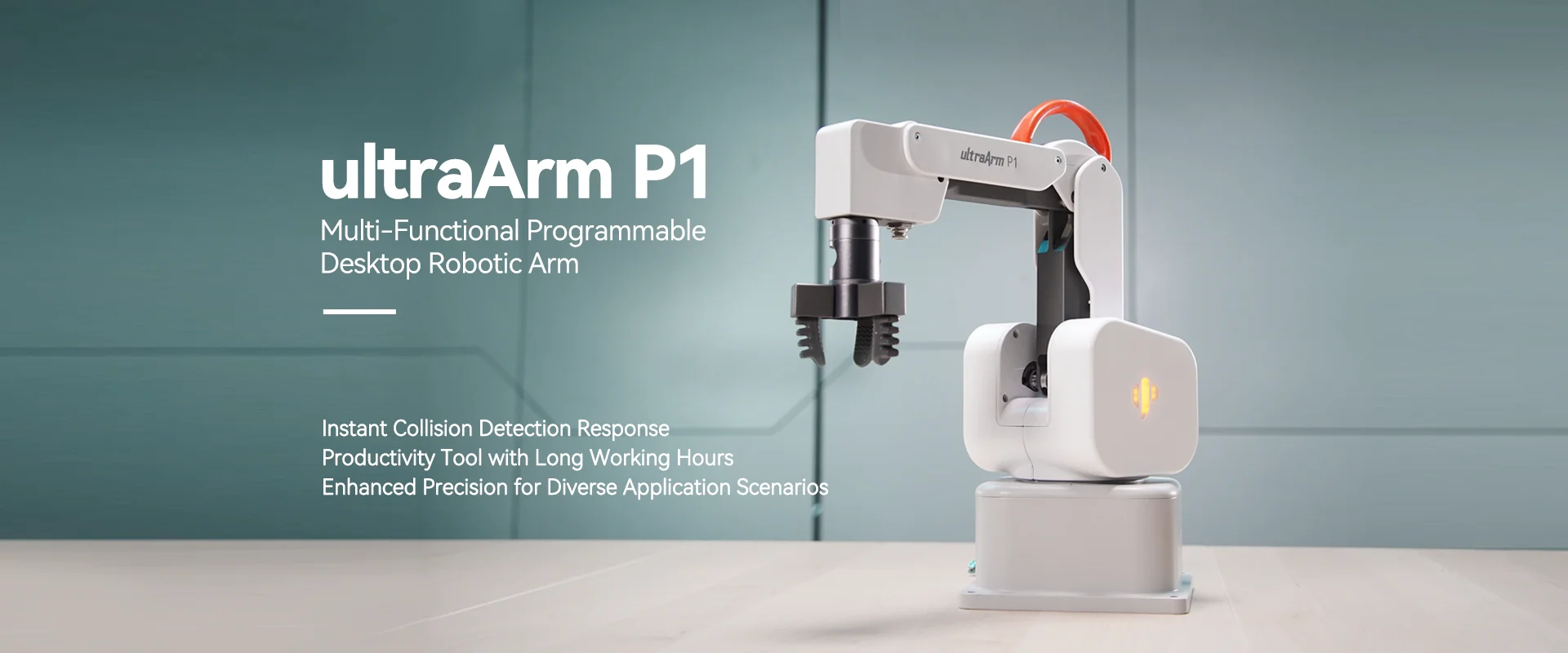
Elephant Robotics launches ultraArm P1, a robotic arm combining precision control, flexible programming, and intelligent safety for education and automation.
SHENZHEN, GUANGDONG, CHINA, July 29, 2026 /EINPresswire.com/ — As robotics education, scientific research, and intelligent automation continue to evolve, demand is growing for robotic platforms that combine professional-level performance with intuitive operation. Students, educators, researchers, and developers increasingly require robotic systems that are not only capable of precise motion and advanced programming but also easy to deploy, experiment with, and integrate into real-world applications. To address these evolving needs, Elephant Robotics has launched ultraArm P1, an upgraded multifunctional intelligent palletizing stepper robotic arm based on the company’s widely adopted ultraArm P340 platform. Designed for robotics education, academic research, prototype development, and commercial applications, the 4-DOF programmable desktop robotic arm introduces a range of improvements in control, interaction, and deployment, including drag-and-teach programming, absolute encoders, collision detection, a built-in LCD screen, dual-core control architecture, and a 20 mm extended working radius. With enhanced usability, improved motion performance, and flexible development capabilities, ultraArm P1 provides a practical robotic platform that supports users throughout the full learning and innovation journey—from introductory robotics education and hands-on experimentation to advanced algorithm development and application deployment.
Precision Motion Control with Intuitive Operation
Powered by an STM32 and ESP32 dual-core control system and Elephant Robotics’ proprietary motion control algorithms, ultraArm P1 delivers stable, precise, and responsive robotic performance. The palletizing robot arm features a 650g payload, 360mm working radius, and ±0.1mm repeatability, delivering the precision and performance required for robotics education, laboratory experiments, automation demonstrations, and research applications. To improve usability and learning efficiency, ultraArm P1 integrates a 2.4-inch LCD screen that provides real-time visualization of important operating information, including joint angles, end-effector coordinates, and IO signals. Users can directly monitor and perform basic operations through the onboard interface without requiring additional software, making it easier to understand robotic motion, kinematics, and control principles. Equipped with high-resolution absolute encoders, ultraArm P1 can retain position information even after power loss, reducing repeated calibration and improving operational efficiency. The built-in control buttons support zero-code drag-and-teach programming, trajectory recording, and quick movement control, enabling beginners to quickly complete basic robotic tasks without complex setup. These features lower the entry barrier for robotics education while improving efficiency in laboratory testing, automation simulation, and interactive demonstrations.
Flexible Programming from Learning to Advanced Robotics Development
Designed to support users at different skill levels, ultraArm P1 provides a complete development pathway from beginner programming to advanced robotics research. For beginners, the graphical programming platform myBlockly provides an intuitive entry point to robot programming through visual coding and hands-on learning. This enables ultraArm P1 to support a wide range of educational applications, from introductory robotics and kinematics experiments to control theory and interdisciplinary STEAM projects. For advanced users, the robot supports professional development environments including Python, ROS 2, and C++. Developers and researchers can use these tools for application development, robotic system integration, motion control optimization, vision-based robotics research, and multi-robot collaboration experiments. Beyond software flexibility, ultraArm P1 supports multiple operating systems and a wide range of communication interfaces, including Wi-Fi, RS485, USB, and Bluetooth. With open interfaces, hardware expansion capabilities, and standardized communication protocols, the robotic arm enables seamless integration with external devices and control systems, providing a flexible foundation for customized robotics applications and system development.
Intelligent Safety Features for Reliable Human-Robot Collaboration
Safety and reliability are essential for robotic systems used in classrooms, laboratories, and interactive environments. ultraArm P1 incorporates multiple safety mechanisms designed to support secure human-robot collaboration and reliable operation. The robotic arm features Elephant Robotics’ self-developed collision detection system, which can identify abnormal contact and stop motion within milliseconds. This helps reduce operational risks during drag-and-teach programming, palletizing tasks, object handling, and classroom demonstrations. The robot also adopts a fully enclosed body design and integrated power-routing structure, improving durability, reliability, and overall appearance while providing a cleaner and more streamlined structure. In addition, triple electrical protection mechanisms help prevent risks associated with short circuits, open circuits, and reverse connections, ensuring stable operation across education, research, and commercial demonstration scenarios.
Versatile Applications with Flexible Expansion Options
To support diverse robotics applications, ultraArm P1 is compatible with multiple interchangeable end effectors, including a quick-change pen holder, flexible gripper, suction pump, and laser engraving head. These accessories enable a wide range of tasks, including writing, drawing, palletizing, object handling, and laser engraving, allowing users to quickly adapt the robot arm for creative, educational, and automation scenarios. Elephant Robotics also provides 3 ready-to-use application solutions covering drawing and writing, laser engraving, and vision-based picking, helping educators, researchers, and developers quickly build robotics demonstrations and experimental projects. For advanced robotics development, ultraArm P1 can seamlessly integrate with Elephant Robotics’ myAGV 2023 and myAGV Plus to build compound mobile robot systems that combine mobility and manipulation capabilities. This enables expanded applications, including autonomous handling, mobile inspection, and intelligent automation workflow validation. With its flexible hardware expansion and application-oriented design, ultraArm P1 serves as a practical platform for hands-on robotics education, prototype development, academic research, and small-scale automation applications.
By combining precise motion control, flexible programming capabilities, versatile application options, and intelligent safety features, ultraArm P1 reflects Elephant Robotics’ commitment to making professional robotics technology more accessible to students, researchers, developers, and innovators worldwide. Bridging the gap between user-friendly educational platforms and advanced robotic systems, the palletizing robot empowers users to explore robotics, accelerate innovation, and develop intelligent automation solutions for the future. For more information about ultraArm P1, visit Elephant Robotics’ official website at https://www.elephantrobotics.com/en/ultraarm-p1/ or contact the sales team at sales@elephantrobotics.com.
Marketing & Sales team
Elephant Robotics
+86 181 2384 1923
email us here
Visit us on social media:
LinkedIn
Instagram
Facebook
YouTube
TikTok
X
Other
Legal Disclaimer:
EIN Presswire provides this news content “as is” without warranty of any kind. We do not accept any responsibility or liability
for the accuracy, content, images, videos, licenses, completeness, legality, or reliability of the information contained in this
article. If you have any complaints or copyright issues related to this article, kindly contact the author above.

Media gallery