SHENZHEN, GUANGDONG, CHINA, October 23, 2026 /EINPresswire.com/ — Designed as a practical procurement and technical evaluation guide ahead of CPHI China, this FAQ guide aims to clarify key sourcing considerations for international procurement managers, brand owners, and research scientists in the global nutraceutical and pharmaceutical sectors.
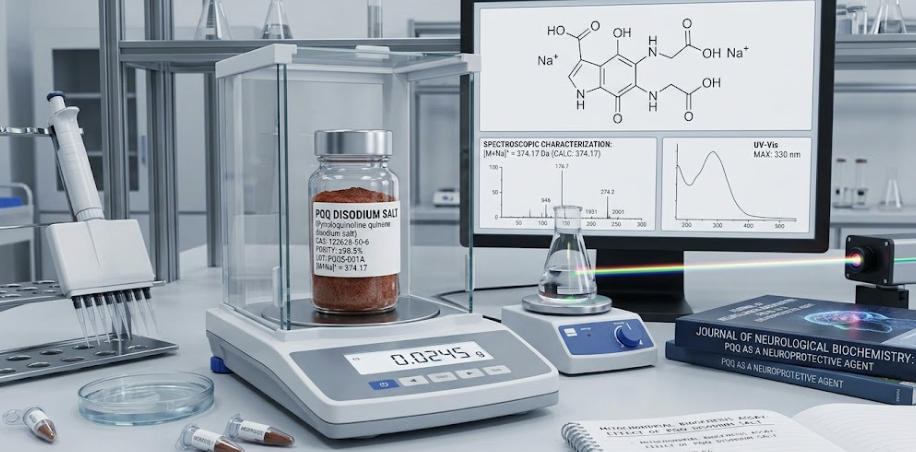
Among the growing portfolio of cellular health and mitochondrial support ingredients, Pyrroloquinoline Quinone disodium salt has emerged as a high-demand active component for next-generation cognitive, anti-aging, and metabolic health formulations. However, selecting a reliable, high-purity Professional PQQ Disodium Salt Supplier requires rigorous evaluation beyond basic price points and analytical certificates. PQQ Disodium Salt, a redox-active o-quinone coenzyme compound (molecular formula C14H4N2Na2O8), plays a central role in promoting mitochondrial biogenesis and scavenging cellular reactive oxygen species (ROS). Given its bioactivity and precise dosage requirements, securing a consistent supply from an established manufacturer with robust bioprocessing and safety validation capabilities is critical prior to major trade exhibitions.
Exhibitions like CPHI China serve as essential global platforms for sourcing functional ingredients, connecting manufacturers directly with international brand developers. Navigating such trade shows effectively demands a structured sourcing strategy. Before arriving at the exhibition floor, procurement teams typically review raw material specifications and audit documentation. During the event, buyers examine physical product characteristics, evaluate particle size and bulk density, and engage directly with technical specialists. On-site technical discussions allow buyers to verify critical quality parameters, including purity levels, heavy metal limits, residual solvent controls, and batch-to-batch consistency across various assay standards. Following the exhibition, qualified buyers often conduct facility audits, laboratory tours, and pilot-scale trials to validate manufacturing protocols before finalizing long-term commercial agreements.
Q1: How Does Synthetic Biology and Strain Engineering Impact PQQ Disodium Salt Quality?
A1: Advanced Enzyme Engineering and Directed Evolution Ensure Superior Molecular Purity and Yield
The foundational quality of PQQ Disodium Salt is determined at the strain construction and bioprocessing stage. Traditional chemical synthesis pathways often struggle with complex multi-step reactions, potential trace organic solvent residues, and environmental waste burden. Modern industrial biotechnology utilizes precision biosynthesis to produce bio-identical functional molecules with high efficiency.
Advanced biological platforms leverage proprietary strain construction technologies, such as the Zymevolver strain construction and enzyme engineering evolution platform developed by Hygieia, to optimize microbial production hosts. By engineering metabolic pathways and refining key catalytic enzymes, biomanufacturers enhance target yields while minimizing unwanted metabolic side-products. For brand owners, sourcing PQQ Disodium Salt derived from enzyme-engineered bioprocesses ensures a clean impurity profile, exceptionally high purity (98% or 99%), and consistent batch stability necessary for complex multi-ingredient capsule, tablet, or powder matrix formulations.
Q2: What Technical Capabilities Define a Reliable Biosynthetic Ingredient Manufacturer?
A2: Integrated Capabilities Across Strain Design, Fermentation, Purification, and Scale-Up Processing
A competent raw material supplier must demonstrate comprehensive control over the entire technical supply chain rather than relying solely on third-party toll processing. When evaluating potential partners ahead of industry tradeshows, procurement teams should look for integrated industrial capabilities spanning several key areas:
Strain Design and Genetic Optimization: Proprietary microbial engineering capabilities that allow continuous optimization of production hosts.
Precision Fermentation and Bioprocessing: Fully controlled bioreactor systems that maintain optimal growth, oxygenation, and substrate conversion parameters.
Downstream Purification Engineering: Advanced separation, crystallization, and drying techniques tailored to maintain the stability of redox-sensitive coenzymes like PQQ.
Industrial Scale-Up Support: Demonstrated capacity to transition processes smoothly from laboratory proof-of-concept to multi-ton commercial production without compromising product specifications.
Companies operating as high-tech enterprises centered on biosynthetic technology leverage these integrated capabilities to maintain tight batch-to-batch control, preventing batch variance and supply chain bottlenecks for international buyers.
Q3: Why Are Comprehensive Safety and Efficacy Validation Systems Essential for PQQ Sourcing?
A3: Rigorous Testing Protocols Provide Foundation for Regulatory Compliance and Consumer Trust
In the global health and nutrition market, ingredient purity must be backed by transparent, verifiable quality assurance systems. A professional supplier operates beyond simple raw material synthesis, implementing a comprehensive safety evaluation system and a professional efficacy validation system to establish rigorous quality foundations.
When auditing a PQQ Disodium Salt manufacturer, buyers should verify the presence of thorough analytical testing protocols, including High-Performance Liquid Chromatography (HPLC) for assay verification, Inductively Coupled Plasma Mass Spectrometry (ICP-MS) for heavy metal profiling, and full microbial panel screening. In addition to physical-chemical safety, leading biomanufacturers validate ingredient performance through cellular research, functional testing, and stability studies. This commitment to scientific documentation simplifies regulatory filings across international jurisdictions and supports consumer brand credibility.
Q4: How Can Brands Benefit From One-Stop OEM/ODM and Custom Formulation Support?
A4: Full-Process Service Solutions Bridge the Gap Between Raw Active Ingredients and Market-Ready Finished Products
Sourcing high-quality raw materials is only the first step in successful product innovation. Brand owners increasingly seek ingredient suppliers capable of providing end-to-end support, ranging from raw material development and formulation optimization to custom formula design and finished product OEM/ODM manufacturing.
Working with an integrated solution provider allows nutrition, beauty, and healthcare brands to leverage specialized dosage delivery innovations, including:
Hard Capsules and Softgel Formulations: Optimized filling parameters for stable micro-dosage active ingredients.
Micro-pills and Oral Thin Films: Advanced delivery systems designed for enhanced bioavailability and precise nutrient release.
Powder Blends and Functional Gummies: Custom premix development tailored for specific taste, solubility, and stability requirements.
By collaborating with a partner that offers both high-purity ingredients-such as MITO GUARDIAN PQQ Disodium Salt, Ca-AKG, NMN, DCI, and L-5-MTHF-and technical OEM support, enterprises in nutrition and health, beauty and skincare, biomedicine, and animal healthcare can accelerate product development timelines while maintaining strict quality standards.
Q5: What Key Differences Distinguish a Professional Biosynthetic Manufacturer From Standard Traders?
A5: Comprehensive Evaluation Across Core Technology, Production Transparency, and Full-Process Capabilities
When evaluating suppliers ahead of CPHI China, procurement professionals should analyze the structural differences between intermediate traders and integrated biosynthetic manufacturers across several critical dimensions.
Standard traders and intermediate vendors typically source raw materials from external tolling facilities with limited control over strain engineering, rely on third-party supply chains that introduce multi-layer price margins, and provide basic Certificates of Analysis without deep batch-level traceability. Furthermore, their product scope is often limited to isolated bulk powder trading without technical formulation support.
In contrast, professional biosynthetic manufacturers operate proprietary strain construction and enzyme engineering platforms, ensuring direct control over genetic stability and process parameters. They maintain integrated fermentation, purification, and scale-up facilities that deliver transparent production quality and cost control. In addition to offering comprehensive safety evaluations and multi-batch validation systems, these manufacturers provide a broad cellular health ingredient matrix (such as PQQ, NMN, Ca-AKG, and Urolithin A) accompanied by full-process OEM/ODM services from raw material synthesis to finished product manufacturing.
Corporate Information & Contact
For more information regarding high-purity PQQ Disodium Salt, custom formulation development, or to schedule a technical consultation ahead of CPHI China, please visit the official company website:
https://www.hygieiabiotech.com/
Hygieia
Hygieia
Legal Disclaimer:
EIN Presswire provides this news content “as is” without warranty of any kind. We do not accept any responsibility or liability
for the accuracy, content, images, videos, licenses, completeness, legality, or reliability of the information contained in this
article. If you have any complaints or copyright issues related to this article, kindly contact the author above.

Media gallery